
I want to praise a recent documentary film, Learning the Dance: Community Making a Difference, made by Lisa and François Balcaen in 2018 about two students, their families, and educators at a school district in rural Manitoba.
Learning the Dance [48 min.] introduces us to Arielle and Troy, two grade seven students (at two different schools), who both live with the challenges of fetal alcohol spectrum disorder. It shows teachers, administrators, and support staff from the Seine River School District working in remarkable ways to support these two students. The film represents a high-water mark in recent attitudes towards supporting and respecting the rights of this cohort of neurodiverse children.
The “dance” of the film’s title refers to the different sorts of expectations and practices that are necessary in and around classrooms in order for kids with an FASD to be able to fit in, have some successes, and so develop a positive attitude about learning and school. The key principles are to modify the environment so that it does not overwhelm or agitate the child, and to nurture the teacher-student relationship with an emphasis on mutual trust over reward / punishment.
The older expectations and practices — which, unfortunately, continue to predominate in school systems across North America — focus on behaviour, managing it and correcting it where possible. They tend to make antagonists out of children with these special brain-based needs, pushing them into “behavioural” classes and, all too often, by their teen years, out of school altogether.
Learning the Dance is deeply moving to me as a parent of neurodiverse children. It shows what is possible when a critical mass of educators at any school become informed about fetal alcohol spectrum disorders, once they understand that challenging behaviour in these instances has its origin in brain-based impairments that can be, with knowledge and foresight, accommodated and supported. Like the mother of Troy in the film, I too want to know that my child will not just be “discarded” and excluded because she lives with this disability.
As a teacher, I am touched as well by the (mostly) young educators in the film who demonstrate flexibility and the willingness to try new approaches, and who manifest such a profound compassion and commitment to Arielle’s and Troy’s learning. These teachers and administrators understand that the effort to be inclusive is most developmentally consequential during the school years. Learning the Dance shows just how much children with a neurodevelopmental disability can contribute to a school’s community. The film is especially beautiful for capturing how hard Arielle and Troy work to learn and to give of themselves, how much they want to belong, how much their achievements mean to them.
While thinking about Learning the Dance, I recall a film that came into the world twenty-one years earlier, Métis filmmaker Gil Cardinal’s David with FAS [44 min.]. It is interesting to reflect on differences between the two films, on changes in how we understand the disorder, how we think about neurodiversity, and more.
Cardinal (1950-2015) is probably best known for his 1987 documentary Foster Child. Many see that film as an indictment of the built-in racism of Canada’s child welfare system. When I completed the required classes in 2007 to become a foster parent with Alberta’s Ministry of Children Services, our trainers screened Cardinal’s Foster Child to sensitize us to the still relevant issues the film contends with. Foster Child is a layered work. It explores Cardinal’s own tragic family history and considers the broader effects of colonialism on Indigenous peoples. But it does not discount the social and legal imperative to protect children from harm.
David with FAS, made in 1997, continues Cardinal’s reflections upon some of these issues. It is a raw and mostly pessimistic film, with no simple take-away. It tells the story of, and is narrated partly by, a young man named David Vandenbrink, who has discovered only at age eighteen that he has the disorder. David’s own meditations on his difficult childhood and current life situation are interwoven with footage of the filmmaker’s interviews with David’s adoptive mother, father, and sister. None of the documentary is shot in a school setting, and the strong implication is that school has not gone well for David.
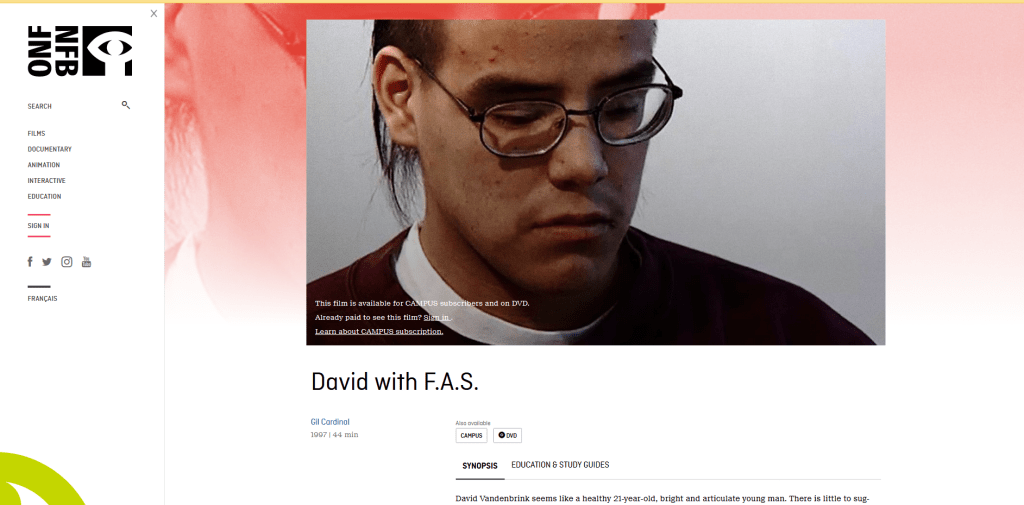
(You will need to have a campus subscription to access the streaming version of Cardinal’s David with F.A.S. [https://www.nfb.ca/film/david_with_fas/]; alternately, you can purchase a DVD of the film from the National Film Board.)
In the twenty-five years since David with FAS was made, there have been immense advances in medical but also social understanding of the disorder. A lot more is known now as well about how to support people affected by prenatal alcohol exposure. I think it’s worth summarizing these changes and their import.
For one, the medical name of the disorder has changed — from “fetal alcohol syndrome” to “fetal alcohol spectrum disorder — and that change reflects the knowledge that the physical and neurological effects of prenatal exposure really do occur on a spectrum. No person with an FASD, that is, manifests the disorder in exactly the same way as another. There is a core of common traits, such as impaired executive functioning, impulsivity, ADHD-like “fast brain” behaviour, difficulties with emotional self-regulation, and difficulties in reading the physical cues of others. But beyond that core, there are many other physical effects that appear in some people diagnosed with the disorder and not in others.
Another crucial piece of new knowledge: fetal alcohol disorders are much more widely prevalent in the general population than was previously thought. When David with F.A.S. came out, in 1997, the medical estimate of prevalence was less than 1% of the general population. But as of 2023, the Alberta government’s own dedicated web-page estimates prevalence at 4% of the general population (https://www.alberta.ca/fasd-in-alberta.aspx#jumplinks-1). 1 That means there are more people living with an FASD than with all of the other well-known neurodevelopmental disorders, including autism. (All kudos to the autism community, by the way, for making great and inspiring inroads with regard to school inclusion and finding broad community understanding; this is the direction that Canada needs to go in to support people with fetal alcohol disorders too.)
A remarkable — and hopeful — thing about Learning the Dance is that it shows, in the twenty years elapsed since David with F.A.S., a cluster of educators (not in a big city either!) who have intelligently absorbed the findings of neurological science and who also (and not coincidentally) take a more enlightened view of disability than was ever possible in the late nineties. That is, these teachers and administrators and teacher’s aides understand “not to take it personally” when a child with an FASD gets dysregulated or overcome by fear or anxiety. They understand about the relation between executive function and behaviour. They grasp how traditional notions of discipline and consequences will have little utility for children with brain-based impairments of this sort. And they are able to think about alternatives!
(For all of this, I’m going to say that much credit is due to Lisa Balcaen, a researcher and early childhood program coordinator with Seine River, for educating and advocating in her own school district. Her advocacy in turn builds upon a couple of decades’ work by others across North America, most notably perhaps social worker and parent Diane Malbin’s groundbreaking neurobehavioral approach. At the time that Cardinal’s film was made, it should be said, almost nothing was known about “trying differently rather than harder.” 2 )
For me, the saddest moment in David with F.A.S. comes during an interview with David’s adoptive father, a man of European origin and a police officer. David’s belated diagnosis with what was then called “F.A.S.” fills his father with anguish and grief because he realizes, too late, that his son’s challenges with time, and motivation, and organization, and getting through school were not in fact problems that could be addressed in disciplinary ways. He confesses to Cardinal that his frustrated attempts to force his boys to try harder look, in the light of this new knowledge, like abuse. I think this message is the crucial one in Cardinal’s film, which in other respects perhaps crosses over too much into a narrative of doom and despair: the sooner a child with a fetal alcohol disorder can get a proper diagnosis of the condition, the sooner that child can get the supports and accommodations he will need to make it through adolescent and adult life. Waiting until eighteen is too late — by that time, the chronic misunderstanding and heavy-handed attempts at discipline or correction a child with this disorder will face at every turn will have inflicted their lasting harm.
The Balcaens’ Learning to Dance was funded by a Manitoba coalition doing the good work of promoting the dignity of people who live with fetal alcohol disorder. We understand better now than twenty-five years ago how the weight of shame and stigma can be crushing for families supporting someone with this brain-based disability. We all can do our part to help those families lift that burden. It needs to be more widely acknowledged that an FASD is a form of neurodiversity. Arielle and Troy embody this truth; my daughter does too. It is a disorder that shapes one’s life from beginning to end. If we can shift the discourse around it away from metaphors of brokenness and damage, and away from finger-pointing and blaming, towards supporting people who will need our compassion and understanding through their entire lives, we will be helping a significant number of our fellow human beings in profound ways.
It is 2023 now, not 1997. Many more of us can learn this dance, across every province and territory in Canada, consistently, equitably, in big city school districts — Edmonton Public School Board, I am looking at you! — as well in the unexpectedly vanguard rural districts of a few parts of the country. We can do more everywhere to help the most vulnerable members of our communities.
We can all learn the dance. And the world will be a better place for it.
1 The Alberta government’s current estimate is based upon authoritative recent studies such as Svetlana Popova et al. World Health Organization International Study on the Prevalence of Fetal Alcohol Spectrum Disorder (FASD): Canadian Component. CAMH Publications, 2018; and P. A. May et al. “Prevalence of Fetal Alcohol Spectrum Disorders in 4 US Communities.” JAMA 319.5 (2018): 474–482.
2 Diane Malbin. Trying Differently Rather Than Harder: Fetal Alcohol Spectrum Disorders. 3rd edition. Fascets, 2017.
 WALKING THE ROAD