Disability advocate CJ Lutke wrote recently that when she was growing up, Amelia Bedelia was the closest thing she ever came across to a representation of herself in a book or movie. Amelia Bedelia, the children’s book character, is quirky, spontaneous, and tends to take figures of speech literally (she “undusts” a room, for e.g., since dusting it for her would mean getting it dirty). Amelia Bedelia could plausibly be claimed as one of their own by a number of neurotypes, but then again you might just see her, as most of her legions of readers have done, as a free spirit. In contrast, just about every explicit mention in popular culture of anyone who lives with a fetal alcohol spectrum disorder tends to diminish, to cast shame, to spread untruths. I agree wholeheartedly with Lutke that there is a great deal of positive, reconstructive cultural work to be done.
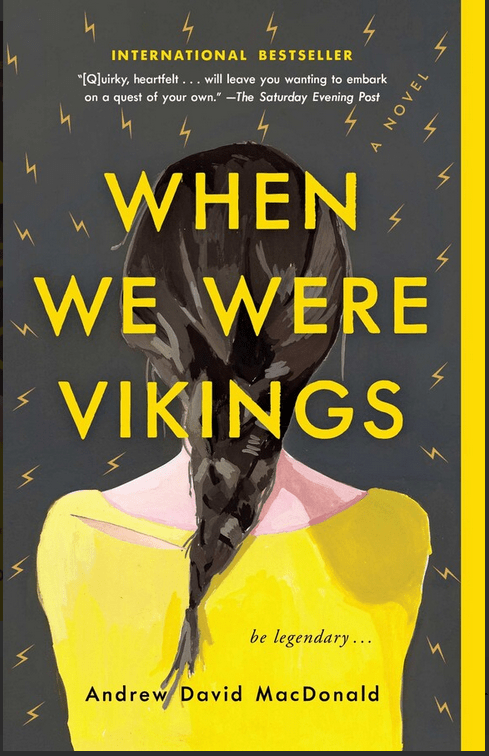
For this reason, I am full of praise for the intent behind Andrew David MacDonald’s novel When We Were Vikings [Simon & Schuster, 2020], whose narrator and heroine is a plucky, imaginative, articulate young woman named Zelda who also happens to have FASD. The emotional core of the story is the relationship between the dependent Zelda and her older brother Gert. The adults in Zelda and Gert’s life are gone or were never present. Their father ran off when they were little, their mother was an alcoholic who died young of cancer. Zelda (though not Gert) was prenatally exposed to alcohol. In the present moment of the narrative, Zelda lives with Gert, and he is in effect (if not legally) her guardian. But Gert has troubles of his own: he is gang-involved and dealing drugs; his university studies have run into trouble. His girlfriend Annie (or “AK47”) — a tough, compassionate, level-headed young woman adored by Zelda — has left Gert because of his bad decisions. The question of Zelda’s independence and autonomy will have to be resolved by the book’s end.
Like Amelia Bedelia, Zelda is quirky (that word!), charming, spontaneous, and tends to take figures of speech literally. But her free-spiritedness is not the whole of her story. Some of Zelda’s personal qualities are associated with being on the “spectrum” of fetal alcohol disorders. MacDonald captures them well in When We Were Vikings: Zelda’s impulsiveness, her acute observation, sensory receptiveness and irritability, her impaired capacity to self-regulate her emotions, and her limited ability to read social cues and body language (what psychologists calls “adaptive functioning”). Interestingly, as is often the case with children and youth with an FASD, we learn that there is trauma as well in Zelda’s past.
I have a couple of observations about the novel both as the parent of a child with an FASD and as someone who gets paid to (among other things) think about novels and poems and literary forms. I’ll start with the critical thought, which is that there is a basic flaw — or, better, limitation — in the narrative structure of this otherwise smart and sympathetic novel. Zelda is the first-person narrator of When We Were Vikings. Everything a reader sees and becomes aware of in the narrative comes to us through Zelda’s perceptions. Zelda is not an unreliable narrator exactly — it is essential to the drift of the story that she be an innocent with a good heart. Not only that, but her powers of observation and recollection — not to mention her capacity to record and move seamlessly between direct and indirect speech(!) — are superb. (When We Were Vikings is no different from any other artful narrative in the way that it builds up its central illusion.)
Still, Zelda’s perspective is limited in that she has a younger or more naive person’s understanding of what she observes (of the signs of Gert’s involvement in drug dealing, for instance). She has “cognitive issues” (108), as an exasperated Gert tells a cop during a high-stress traffic stop. Gert is referring not to Zelda’s intellect or eagle-eyed observation but to the way in this instance that she follows him out of the car — to her impulsiveness and inability to read cues.
So the novel has a built-in irony, but the point of that irony is not to make us distrust the narrator or doubt the truth of the account of her life she gives us. That would be deadly for the integrity of the story MacDonald tells. Zelda’s narration moves us, through her relationship with AK47, toward the insight that Gert, despite his own positioning of himself as Zelda’s protector, has actually been endangering her. Gert has also been standing in the way of her independence. The internal contradiction in the narrative is that the reader must be led to discern that Gert’s mistakes endanger Zelda exactly because she does not have an adult’s judgment. They endanger her because she needs support and guidance in the area of frontal lobe function — what caregivers in the FASD-world call an “external brain.” Interestingly, the extra powers of awareness and implicit judgment carried in MacDonald’s narrative are analogous to an “external brain” for Zelda (though maybe only a caregiver-critic like me would ever notice it).
For example, consider the gangsterisms through When We Were Vikings, all the laconic tough guy talk and the implicit menace acted out in the body language of dominance and submission. Notice how this familiar genre situation looks rather different when you put someone into it, someone who also happens to be your narrator, who can only make sense of a small part of what’s going on:
“So the chicken and egg are in bed together,” Hendo said.
“Can you just deal?” the Fat Man said.
Hendo passed out cards and kept talking. “So the chicken is really happy. Big fucking smile on its face.”
He finished dealing the cards and everyone picked them up.
“And then the egg, really frustrated, goes, ‘Well, I guess we answered that question.’”
“Ha ha,” one of the other players said.
“I don’t understand,” I said. “What was the question?”
The man in the red hat lit another cigarette and turned to the Fat Man. “Is she for real?”
I said that I was for real, but that I still wanted to know what the question was. Hendo said that the joke was that the egg and chicken just had sex, and that the chicken got off first and the egg was angry because it wanted to get off but it wasn’t going to happen.
“Why wasn’t it going to happen?” I asked, and was going to add “and what is it?” but people do not like it when you ask too many questions at once.
“Is she retarded or something?” the man in the red hat asked, and the Fat Man punched him in the arm.
“That’s actually not an okay thing to say,” I said. “Like the n-word.” (24-25)
Zelda doesn’t know how to do this language game, which is somewhat comical, but it is a dark sort of comedy, as some book bloggers noted when the novel first came out. That is, by bringing her into contact with his thuggish buddies, Gert has put Zelda in real danger. Young people with an FASD are greatly vulnerable to criminal and sexual exploitation. This aspect of the novel is in contact at least with a disturbing truth, a truth that is complementary to the sub-plot involving Zelda’s awkward first-time attempts at having sex with her adult autistic boyfriend Marxy (as arranged and overseen by AK47 and Marxy’s well-heeled mom). These episodes in the book read like charming — some might say icky — public service announcements, so maybe it’s worth spelling out the point that the themes of self-determination and autonomy MacDonald is developing — some might say belabouring — in them are a counterpoint to the equally pertinent themes of exploitation and abuse that are even more prominent throughout.
Which brings me to a related observation that comes out of my experience as the parent of a kid with a fetal alcohol spectrum disorder. To my mind, When We Were Vikings does not take up too searchingly the question of autonomy and inter-dependence. Certainly, it shows us a village of sorts — a number of decent secondary characters who seem to grasp Zelda’s needs, and who will support her in limited ways once she has moved into an apartment of her own. This is idealistic, and hopeful, and wonderful in its way. But with Gert out of the picture at the end of the novel, and AK47 leaving town for a while, it is not at all clear to me that Zelda will be okay. The “cognitive issues” that made her vulnerable to the gangster boys will continue to make her vulnerable — not just to gangsters and con artists, but to many normative aspects of the neurotypical, middle-class world. The novel is designed to be uplifting and so it is; but I cannot help but feel that for all its good work of positive representation this story leaves us in a premature state of uplift. (MacDonald’s backstory, for instance, says nothing about how Zelda made it to age twenty-one relatively unscathed by her years in school — the time when most people with an FASD run into turbulence.)
When We Were Vikings is clearly modelled on, and was promoted as following in the track of, Mark Haddon’s brilliant and very successful The Curious Incident of the Dog in the Night-Time [2003]. MacDonald’s book is also, for better and for worse, a specimen of the risk-averse North American book industry of the 2020s. (One can imagine the corporate team that put heads together to devise its punchy-sounding title, for instance, which isn’t quite right for the part played by Viking lore and history in the narrative itself — i.e., Zelda isn’t looking back on a time when she was a Viking.) The narrative is skilfully written, wiped clean of local and regional markers, and its cinematic scenes could certainly be translated into Hollywood film. The book itself has a highly professional gloss (some money was spent on cover design, for instance, and then some more on promotion and marketing), with only the occasional lapse such as the inexplicable way that Simon & Schuster’s promotional team uses the 1980s-era name of the disability — FAS, or fetal alcohol syndrome — rather than FASD.
In short, When We Were Vikings is a good book, worth reading for MacDonald’s skill with narrative, scene-setting, and direct and indirect dialogue. I recommend it; get yourself a copy. What remains for me, though, are questions about “positive representation.” Does a talented young author’s conjuring of a charming and memorable character amount to anything against the destructive might of deeply entrenched economic, social, and cultural patterns? One might say, well, Haddon’s book caught the early wave of a very successful advocacy movement for people on the autism spectrum in particular and for neurodiversity in general. That’s what positive representation can do. Now there are comedies on Netflix with characters who are on the spectrum, played by neurodiverse actors. Being (lightly) “on the spectrum” is so acceptable it is almost fashionable. Yes, true.
But this sort of cultural turn seems unlikely to be in the cards for people whose neurodiversity happens to originate in prenatal exposure to alcohol. There are a number of complicating obstacles. These include shame — crushing shame and guilt, threatening unacceptably the sentimental picture of the mother in our social imaginary; the snobbery of social class, which has come to accept autism as a white, middle-class disorder but relegates FASD to the scorned, often non-white margins of society; and the deep vein of hypocrisy that enables North America’s long-enduring and abusive love affair with alcohol. More than a story of a plucky young person overcoming villains and family dysfunction and “cognitive issues” and arriving at an uplifting but somewhat implausible independence, maybe what we need to hear about is what happens to the hundreds of thousands of young people with such disorders who do not get diagnosed, who do not get supported by their families nor by anyone in their community until it is too late to help.
A related but very different kind of book, then, is Born Broken: Reflections on Life and Resiliency from Individuals Living with FASD [Bissell Centre, 2023].* Edited by Jared Epp, Born Broken is a nonfiction collection of oral histories and interviews contributed by fourteen people who participated last year in a group called the “Fetal Alcohol Spectrum of Services” at downtown Edmonton’s Bissell Centre. A word about the Bissell Centre: this is a charitable agency that does admirable work with vulnerable people in the Boyle Street area of the city. But the key piece of information perhaps is that nobody arrives at the Bissell Centre unless they have fallen into serious social distress — unless they have hit the skids, to use the common locution. Reading these young adults’ stories, we really should ask, why are they receiving this long-delayed assistance so far downriver? Shouldn’t there be a Fetal Alcohol Spectrum of Services in the city’s schools and communities?
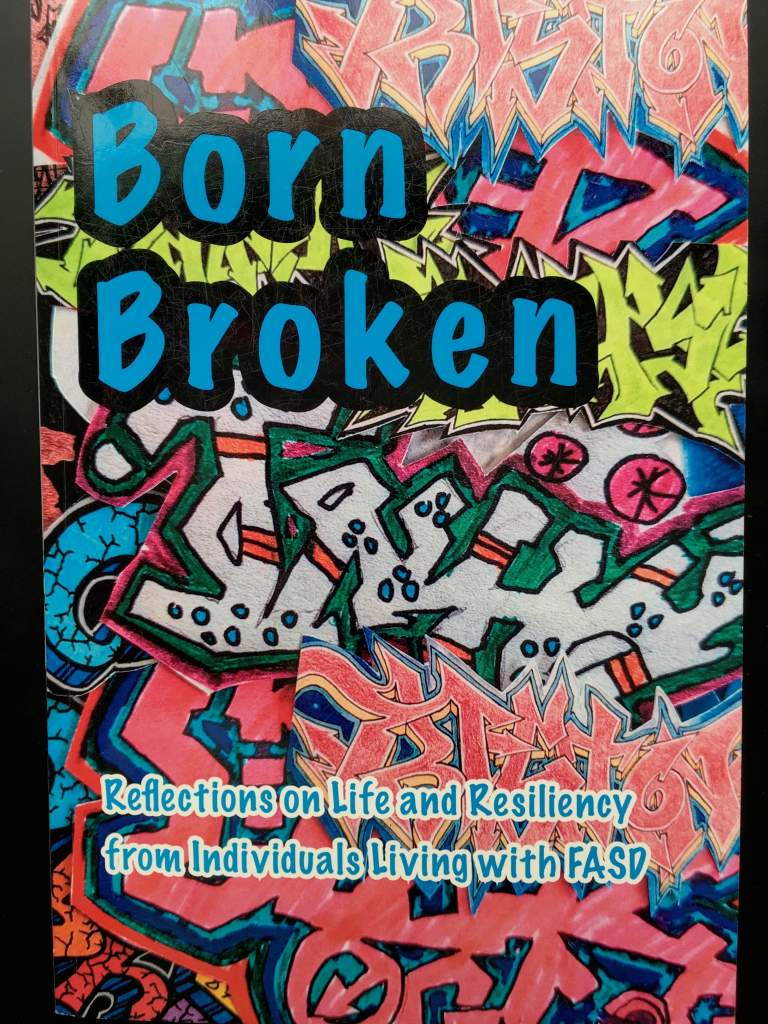
The first-person, nonfictional quality of these short pieces make the book an essential document for understanding how the disorder complicates lives. All of the contributors speak of difficult school experiences, chaotic teen and early adult years — of long delays in getting diagnosed, and hence in grasping the brain-based origin of their troubles, and in finding their way to anything like the supports and assistance that they needed. The middle school years are the time when undiagnosed kids with FASDs tend to go off the rails. Here the testimony of lived experience in Born Broken gives us a fuller picture than fiction can.
According to Epp, there wasn’t unanimity among the contributors about the title of the book. A few felt that it was too negative a characterization, that it reinforced widely held perceptions about FASD. But all agreed that the phrase “born broken” acknowledged a basic truth about living with FASD — that incurable brain injury is a crushingly difficult truth to accept, that it brings shame and guilt and anger in its train, that this difficulty is almost always compounded and magnified by the misunderstandings and harsh judgments of other people (and of family especially). All of the contributors at one time or another appear to have felt this about themselves, and some among them have worked incredibly hard — Viking-like, let’s say — to overcome such a corrosive self-perception.
I will quote from several of the chapters in Born Broken, since they speak movingly to what is lacking in the way of support for people with FASDs in this country. The contributors to this book are brave human beings! I salute them both for what they have been through and for their honesty and candour:
Kendall: “I am 28, I was diagnosed at a late age in my life, 17 going on 18 to be exact; I won’t get into the backstory of why I was diagnosed so late; however, I spend most of my childhood and teen years on Strattera as it was believed I had ADHD… My junior high and high school years were a challenging time for me. School is rough enough as it is without having a learning disability. Kids are mean and judgy if you’re even a little different. … Things like making friends and relationships were hard for me. I have a hard time with social cues. Sometimes I say things before thinking. No filter. I have to be reminded of boundaries sometimes. Sometimes, I do thing without stopping to think, ‘hey is this a good idea’”(8).
Thomas: “They diagnosed me with FASD when I was 8, but they didn’t do nothing about it. They just, you know, let it go over the years. It piled up and the other symptoms later in life bother you. That’s what’s happening now. My diagnosis went untreated so I’m having schizophrenia, PTSD, sleep insomnia. I have a really hard time sleeping at night” (69).
Sophie: “Throughout my life I’ve noticed a lot of people don’t treat FASD as severe as other disabilities. They don’t think it is as bad as autism, for example. Autism is also a spectrum. And it frustrates me a lot. . … [N]ow thinking back at it I probably should have gotten the extra help that I needed. I think a lot of peopIe like that should receive the extra helps especially within public schools…. I find the school system really lacks on [supports for people with disabilities], but what could I do. I’m one person. Growing up realizing all this stuff and then even going out to programs in the city, you have to look for these programs for this help all by yourself. Especially if you don’t have a supportive family. It’s hard to find the support and programs. It took me two years to find a little bit of support. … I think a lot of stuff is lacking in small towns especially public information. A lot of people aka my family, mostly all of them don’t believe I have FASD or a disability in general” (74-75).
Will: “I was in the system pretty much my whole life and when I hit my teens in Edmonton, I started really misbehaving in the group homes and foster homes I was at. From age 13 to now at age 28, I moved 43 times. Due to my behavior in my teens, I was in and out of the youth justice system: jails, psychiatric facilities. They deemed that I had multiple mental health complex disorders. That’s when I found out that I was FASD too. I had no idea. I used to wonder why I was in a special school, like they used to call it. I wondered why I was never put in the regular schools. I felt really down on myself. I felt like an outsider” (49).
Myself, I’m glad for the book’s the title, glad that its contributors were allowed to speak their truths. In the age of “positive representation,” I find that there is strong pressure upon youth and adults living with FASD to downplay the grave seriousness of outcomes in the absence of diagnosis and understanding and support. Let’s rephrase it somewhat: kids with an FASD aren’t “born broken,” but they are born with some of the crucial neurological connections incomplete, and hence if they are going to thrive in the world they will need to fit, and be fitted, consciously and intentionally, into a web of social interdependency that begins with their family and rays out into the surrounding community. Without such a web of supports, without a collective awareness of what kids and youth with FASDs need over the long term, disaster awaits. This is not hyperbole.
I’m a neurotypical parent and writer and I’ve had some frustrating engagements with the scientific / academic side of the FASD-world. (And there is such a research world. No neurodevelopmental disorder has been more studied than FASD.) One part of this culture pursues the neuroscience as if brains were connected always to rats rather than human beings. Meanwhile, in reaction to the disquieting petri-dish and brain-imaging side of research efforts, another part of the FASD-world virtuously overcompensates on combating negative representations and stereotypes. What I wish for instead is that advocacy organizations and research groups in Canada in the 2020s would set aside their acute focus upon correctness of language and instead work in concerted and determined ways to bring about real institutional and social change. The main place where things can improve now is in the schools. (By the way, Canadian Parliament: pass Bill S-253 for a national framework for FASD! As of August 2024, it has languished for more than a year after a second reading in the Senate.)
To sum up, these are two important books — both with an Edmonton connection — about life with a fetal alcohol spectrum disorder. I celebrate Andrew David MacDonald’s creation of such a memorable fictional character as Zelda, and the work his book does in pushing back at a certain kind of shame and stigma and ignorance. But I also am waiting for the day when FASD is no longer the disorder that dare not speak its name — when tens of thousands of young Canadians won’t come to feel, in their forsakenness, that they were “born broken.” A society-wide commitment to understanding and support would show them otherwise.
* Copies of Born Broken are available for sale in Edmonton at Paper Birch Books.
 WALKING THE ROAD