(Dec. 28, 2022; updated Sept. 14, 2025)
Welcome! My name is J. Mark Smith. I’m a writer and literary scholar. And I’m a proud parent of two neurodiverse children.

My family’s story is somewhat out of the ordinary. I tell about it in a work of narrative nonfiction — Motley Green Blanket — that was a hair away from being published by two different university presses but twice (in 2021 and 2023) ran into turbulence associated with the risk-averse culture of the academic world. Despite setbacks, I am committed to publishing this story in the not-too-distant future. The book is a memoir of a decade of foster-to-adopt parenting in Alberta, where I live. Some of what I’ll be eventually doing here is posting snippets of writing excerpted from or related to this book, and maybe even promotional updates about its progress as it gets close to publication.
More to the point, though, is that life keeps happening, and the story of family I tell in the book has kept evolving. A blog, I once hoped, might be a way not to get left utterly behind by the present moment. I imagined I would write miscellaneous thoughts and reflections pertaining to the spinning kinesis of our lives, a year or two further on than you would read about in Motley Green Blanket. But the posts gathered here, composed between 2023 and 2025, add up to something a little different. True, they do not attempt to tell a complete story.
I supposed, though, that the blog would be more up-beat than the book I had written. Trying my best there to tell a full story — as full as I could make it — of how my family came to be, I wrote about complex social phenomena: foster care, adoption from out of foster care, social exclusion and racism, inter-generational effects of violence and deprivation, brain-based disabilities resulting from developmental trauma and prenatal exposure to alcohol and drugs. I recognize that the realities I write about in both the book and the blog — the ways they play out in people’s lives — can be tough to absorb, tough to accept.
The blog posts over the last two years have not been any more light-weight. They have turned, however, more towards advocacy. My thirteen-year-old daughter has a fetal alcohol spectrum disorder. Her big brother, now seventeen, contends with less severe neurological challenges related to attention and executive function. (He has great gifts as well, which make him, like his sister, a joy to know.) One thing I have learned from the great adventure of parenting them both is that we Canadians can and should do much more to support such kids. Sometimes my posts give voice to frustration and disappointment. It turns out I have a lot to say about expert ignorance and institutional backwardness. But the key piece of information for readers is this: that with support and understanding — and accommodation — from family and community, kids with brain-based disabilities can learn and flourish and grow just like everybody else.
My book isn’t dark and despairing — not at all. There’s a lot that’s hopeful in it — reflections on an open adoption and forming connections to people who are very different from oneself, on trauma-informed and neurobehavioural ways of supporting vulnerable kids. Lots of small stories about how attachment and committed relationship and a whole lot of patience can alter the life prospects of children who’ve been in ‘the system’ (i.e., the child welfare system). And a bigger story about how love can deepen and change us all for the better.
So there’s good stuff and there’s difficult stuff. But however difficult some parts of the story are, and however important it may be that a full and nuanced story gets told, it’s also simply true that my kids and I and their mother, Jennifer Stewart (from whom I am separated and with whom I co-parent), have to keep on keeping on. We have to live life, maintain as cheerful an attitude as we can, and look hopefully to the future. Which we do — and sometimes we have the most amazing days! I hope to pass on some positive stories about kids like my kids.
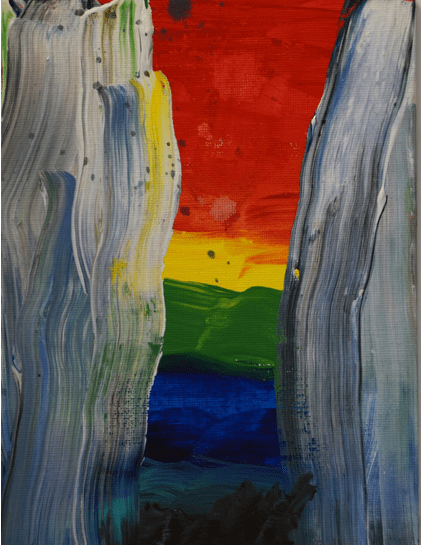
That’s why the header for the blog features “Clouds and Rainbow,” a painting my daughter made when she was ten.

Shanelle painted it on a single tile that she made along with a group of kids who each decorated their own tiles last year for a mosaic to go on a wall at St. Faith’s Anglican church on Alberta Ave in Edmonton. As her mother wrote about Shanelle’s artistic talents: “[She] has an incredible imagination and a wonderful sense of design and colour. She paints quickly and with focus for short periods of time. She always knows when she is done and then she just puts down her brush. Shanelle loves to be outdoors, especially in the mountains, and is a careful observer of nature. She has always been thrilled by the power of thunderstorms.”
(By the way, “Shanelle” and “Louis” are the names I give my children in the memoir; I will continue using those names — not their real ones — here.)
We are proud of how far Shanelle has come in her life journey from toddler to creative preteen girl to feisty teenager. To support her in the world we have needed to acknowledge her ability and promise and what she can give to the world. In the same way, it is vitally important that as a society we recognize the strengths and contributions of all the neurodiverse, vulnerable, and disadvantaged children in our schools and communities, especially the ones who may not have family advocating strongly for them.
As for advocacy, so more work remains to be done! What I have seen in the schools in our city in particular is an educational milieu that seems hardly to have progressed since the mid-1990s — where teachers have not been trained in the most up-to-date brain science or in developmental psychology, where children with complex and non-standard needs get corralled into “behavioural” classes, and where the community understanding and institutional coordination essential for vulnerable, neurodiverse children to thrive is almost everywhere absent.
In future posts, then, I will be directing some energy towards expressing my frustration with current practices in the Edmonton public school system. But, before that, for my next entry, I will be writing about a wonderful 2018 documentary video, Learning the Dance, made by Lisa and François Balcaen about two grade 7 students at a school district in rural Manitoba. It represents for me a high-water mark in recent educational attitudes towards supporting and respecting the rights of children with fetal alcohol spectrum disorders.
 WALKING THE ROAD
2 responses to “Keeping On Keeping On (and Some Days Much Better Than That)”
I can’t wait for the book to come out! Thanks for the preview. This blog is a great idea – I always wonder “what happened next” after reading non-fiction (and fiction too!) so this blog will be a great way to learn more. Thank you.
LikeLike
Really looking forward to reading about your journey!
LikeLike